Cortez Kennedy

Cortez Kennedy Selected for Pro Football Hall of Fame

CortezKennedy
INDIANAPOLIS -- Cortez Kennedy crashed into the Pro Football Hall of Fame the same way he used to crash into people who tried to block the old Miami Hurricane.

Full speed.

“I’ve never been happier,’’ he said. “Well, maybe when we won big games at UM. Or in Seattle. But I’m on top of the world right now for sure.’’
He added jauntily, “Imagine — lil’ ol’ boy from Wilson, Arkansas."

Lil’ ol’ boy isn’t so lil — 298 pounds when he played defensive tackle for first UM and then the Seahawks for 11 seasons, and maybe a lil’ more now.

However big he gets, he won’t outgrow his accomplishments. Kennedy has been a credit to his old hometown, his family, his university and his Seahawks all the time he was bull-rushing past people.

“Coach Dennis Erickson used to tell us good things will keep happening if you keep hustling,’’ Kennedy said. “I don’t know if anything will ever be bigger than winning that ’89 national championship at Miami, but this is nice, real nice.’’

It will get nicer and nicer. Making the Hall is a life-changer. People start wanting to do things for you. Then the main thing you have to worry about is staying out of trouble.

I don’t know that that will be a problem for Kennedy. He has always had a fine head on him. And now he stands alongside Randy White and Mean Joe Greene and Bob Lilly among the greatest defensive tackles of all time.

Oh, yes, another DT, Chris Doleman, was voted in along with Kennedy by the Hall committee. We came out grinning after also picking Jack Butler, Dermontti Dawson, Curtis Martin and Willie Roaf in a 7 hour 48 minute marathon.

FALLING SHORT
It wasn’t that great for candidates who finally fell by the voting wayside — Bill Parcells, Jerome Bettis, Tim Brown, Cris Carter, Eddie DeBartolo, Kevin Greene, Charles Haley, Andre Reed, Will Shields, Aeneas Williams and Dick Stanfel. A lot of those just have to go on waiting.
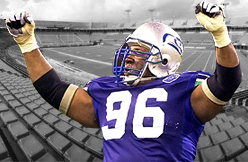
No DT ever made more Pro Bowls than Kennedy’s eight. It was just what Erickson predicted for him early on. To be sure, Kennedy has known heartbreak, too. He changed his uniform number from 96 to 92 for his ’92 season with the Seahawks, to honor his friend and fellow Hurricane, Jerome Brown, after Brown died in a car accident.

But making this Hall of Fame never seemed like anything more than a matter of time for the ebullient buster from Wilson, Ark.

He blew through UM like, well, like a hurricane to become one of the most pro-productive of Erickson’s Canes. The Seattle Seahawks snatched him up as the third player in the ’90 NFL Draft, and he took it from there.

He played in eight consecutive Pro Bowls. He also joined Kenny Easley as the only Seahawks to be named NFL Defensive Player of the Year (’92).

GOOD CITIZEN
One more thing needs to be said about Kennedy. And that is this. Good citizenship is not even remotely a qualification for the Pro Football Hall of Fame. Hall spokesmen go out of their way to emphasize that they deal with on-field football only.

But Kennedy has done it both ways, as a good soldier on grass and an upstanding citizen away from it. He hasn’t been one of those iron-headed saps who figure all they have to do is throw a few guys into the grandstand. Maybe that doesn’t count with the Hall of Fame, but it does with me.


Bookmark and Share
(miamiherald.com)
Comments

2 proCanes are Modern-Era Nominees for 2012 NFL HOF Class

JimmyJohnson
Running back Tiki Barber, quarterback Drew Bledsoe, wide receiver Keyshawn Johnson, guard Will Shields, and coaches Bill Cowher, Bill Parcells, and Marty Schottenheimer are among the 11 first-year eligible modern-era candidates for the Pro Football Hall of Fame Class of 2012.
The complete list of nominees for the Class of 2012 consists of 103 candidates. From that list of nominees, the Pro Football Hall of Fame Selection Committee will choose 25 candidates who will advance as semifinalist nominees. The list of 25 semifinalists will be announced in mid-November.

The list of 25 semifinalists will be further reduced by a mail ballot to 15 modern-era finalists and announced in early January.
The final list of nominees that will be considered for election will consist of the 15 modern-era finalists and the two senior nominees, former Pittsburgh Steelers defensive back Jack Butler and former Detroit Lions guard Dick Stanfel, who were selected this last month by the Hall of Fame’s Senior Selection Committee.

In 2008 the Hall of Fame modified its By-Laws for the Selection Committee making it mandatory for coaches, like players, to be retired five consecutive seasons. Prior to that change, coaches were eligible immediately upon retirement. As such, Parcells was a nominee in 2001, 2002, and 2003 and Schottenheimer was a nominee in 2000. This is their first year of eligibility under the new provision.

The Class of 2012 will be selected from the list of 17 finalists (15 modern-era and two senior nominees). The actual voting will be conducted at the Pro Football Hall of Fame Selection Committee’s annual meeting, which will be held on Saturday, Feb. 4, 2012 the day before Super Bowl XLVI at Lucas Oil Stadium in Indianapolis, Ind. The election results will be announced that evening on NFL Network, live from the Super Bowl Media Center.

While there is no set number for any class of enshrinees, the selection process by-laws provide that between four and seven new members will be selected.

The preliminary list includes 71 players, 14 coaches and 18 contributors, including former NFL Commissioner Paul Tagliabue and longtime team owners Bud Adams, Jr., Jack Kent Cooke, Ed DeBartolo, Jr., and Art Modell.

While a nominated player or coach must have been retired at least five consecutive seasons, a contributor, who is an individual who has made outstanding career contributions to pro football in capacities other than playing or coaching, may still be active in his pro football career.
Class of 2012 Modern Era Preliminary Nominees:

Quarterbacks DREW BLEDSOE, Phil Simms
Running Backs TIKI BARBER, Jerome Bettis, Larry Centers, Roger Craig, STEPHEN DAVIS, Terrell Davis, Eddie George, Curtis Martin, Brian Mitchell (also KR/PR), Gerald Riggs, Herschel Walker, Ricky Watters
Wide Receivers Tim Brown (also KR), Cris Carter, Gary Clark, Mark Clayton, Henry Ellard (also PR), KEYSHAWN JOHNSON, Andre Reed, Sterling Sharpe, Jimmy Smith, ROD SMITH
Tight Ends Todd Christensen, Frank Wycheck
Offensive Linemen Tony Boselli (T), Lomas Brown (T), Jim Covert (T), Dermontti Dawson (C), Joe Fields (C), Jay Hilgenberg (C), Chris Hinton (G/T), Kent Hull (C), Joe Jacoby (T), Mike Kenn (T), Jim Lachey (T), Willie Roaf (T), WILL SHIELDS (G), Steve Wisniewski (G)
Defensive Linemen Dave Butz (DE/DT), Chris Doleman (DE/LB), Carl Hairston (DE/DT), Charles Haley (DE/LB), Ed “Too Tall” Jones (DE), Cortez Kennedy (DT), Joe Klecko (DE/DT/NT), Dexter Manley (DE), Charles Mann (DE), Fred Smerlas (NT)
Linebackers Cornelius Bennett, Kevin Greene (also DE), Ken Harvey, Clay Matthews, Karl Mecklenburg, Sam Mills
Defensive Backs Eric Allen (CB), Steve Atwater (S), Joey Browner (S), LeRoy Butler (S), Kenny Easley (S), Albert Lewis (CB), Donnie Shell (S), TROY VINCENT(CB), Aeneas Williams (CB/S), Darren Woodson (S)
Kickers/Punters Gary Anderson (K), Nick Lowery (K), Reggie Roby (P), MIKE VANDERJAGT (K)
Special Teams Steve Tasker (ST/WR)
Coaches Bill Arnsparger, Bud Carson, Don Coryell, BILL COWHER, Tom Flores, Jimmy Johnson, Chuck Knox, Chuck Mather, BILL PARCELLS, Buddy Parker, Dan Reeves, MARTY SCHOTTENHEIMER, Clark Shaughnessy, Dick Vermeil
Contributors K.S. “Bud” Adams, Jr. (Owner), Bobby Beathard (Admin.), Gil Brandt (Admin.), Leo Carlin (Admin.), Jack Kent Cooke (Owner), Otho Davis (Trainer), Ed DeBartolo, Jr. (Owner), Ron Gibbs (Official), Jim Kensil (Admin.), Eddie Kotal (Admin.), Art McNally (Official), Art Modell (Owner), Steve Sabol (NFL Films), Paul Tagliabue (Commissioner), Burl Toler, Sr. (Official), Jim Tunney (Official), Ron Wolf (Admin.), George Young (Admin.)


Bookmark and Share
(nfl.com)
Comments

Cortez Kennedy falls short in Hall of Fame vote again

Try again next year, Tez.

Former Seahawks defensive tackle Cortez Kennedy was denied entry into the Pro Football Hall of Fame for the third consecutive season, making the cut as one of 10 finalists before falling shy in the final voting.

This year's inductees are Marshall Faulk, Deion Sanders, Shannon Sharpe, Richard Dent, Ed Sabol, Les Richter and Chris Hanburger.
Other finalists who fell short were Curtis Martin, Dermontti Dawson, Andre Reed and Willie Roaf.

Sanders, Faulk and Sharpe were pretty obvious choices, and their shoo-in status figured to make it difficult for Kennedy to gain the recognition necessary to garner enough votes.

Kennedy was an eight-time Pro-Bowler during his 11-year NFL career -- all of it as a Seahawk -- and was a selection on the 1990s All-Decade team.

Kennedy wasn’t flashy, but he got the job done for the Seattle Seahawks during his 11-year NFL career. In eight of those years, Kennedy made the Pro Bowl while also being named a first-team All-Pro three years and a second-teamer two years. Yet Kennedy fell short for the third-straight year when the NFL Hall of Fame announced its class of 2011 on Saturday, a victim of a loaded crop of skill players.

Look at Kennedy’s 1992 season — a year that the Seahawks were abysmal, finishing 2-14. Kennedy, however, led his position in sacks that year, and took home the AP Defensive Player of the Year award for an excellent body of work. He’s one of only five players on a losing team to bring home the award, a testament to an outstanding year.

In five other years, Kennedy registered 6.5 or more sacks, peaking in that 1992 season with 14. Kennedy finished with 568 career tackles, 11 forced fumbles, six recoveries and — wait for it — a defensive touchdown. He was a force to be reckoned with in the middle of the Seattle defense, and a more than worthy candidate for enshrinement in the Hall of Fame.

Kennedy suffered from a Hall of Fame class that was overflowing with talent this year, and it won’t get any easier. Though he made the first cut, narrowing the candidates from 15 to 10, he didn’t make the second, falling just short again. It’s an encouraging sign, but with players such as Warren Sapp and others up for induction in the next few years, his chances remain long.

It’s a long road ahead, but Kennedy took a step in the right direction today. For our sake, let’s hope the Hall of Fame selection committee comes to its senses and puts Big Tez where he belongs: enshrined in the hall.

Click here to order Cortez Kennedy’s proCane Rookie Card.


Bookmark and Share
(seattlepi.com)
Comments

Cortez Kennedy and the Hall of Fame

DALLAS -- All defensive tackles were not created alike. That goes for the great ones, too.

Some are mostly run-stuffers, coming off the field in passing situations. Others rush the passer with little or no regard for playing the run.

Very few could dominate across all situations. Cortez Kennedy could, and did, during an 11-year NFL career that landed him a spot among the final 10 candidates for the most recent Pro Football Hall of Fame class. Kennedy is among the final 15 modern-era finalists again this year, and I'll be presenting his case to the other selectors during our annual meeting Saturday.

Several themes have emerged during my research into Kennedy's career. I'll expand upon them here one by one, drawing upon coaches and players' first-hand knowledge.

Sheer physical dominance
Very good players sometimes enjoy great careers. Some lean heavily on savvy and preparation. Not all of them dominate physically. Kennedy generated superior power and sudden quickness from a massive lower body.

"Cortez was the most dominant interior lineman that we ever faced and certainly the very best against the run," said former Oakland Raiders guard Steve Wisniewski, an eight-time Pro Bowl choice between 1989 and 2001.

Seattle scrapped its 3-4 defense to rebuild around Kennedy at a time when Kennedy's college coach at Miami, Jimmy Johnson, was bringing his 4-3 scheme to the NFL.

"That time in football is when you really got the dominant defensive players inside," Johnson said. "The big, overpowering defensive linemen inside just disrupted everything. Cortez got teams looking for that dominant player."

There's that word again -- dominant.

"He was very dominant and could take over the game," said longtime NFL offensive line coach Howard Mudd, who coached for and against Seattle during Kennedy's career. "He just had great instincts about where the ball was and he was a pass-rusher so you would think, 'Gee, we could run screens on that guy.' But he smelled them out and he was always running into the screens."

Longtime NFL offensive line coach Alex Gibbs said offenses had to plan for Kennedy specifically or pay the consequences, or both. Gibbs coached the lines for three of Seattle's old AFC West rivals across 10 of Kennedy's 11 seasons. He was with Seattle briefly in 2010, and that is when he provided a testimonial.

"The Seahawks were a nightmare because I knew I was going to get them twice a year, and it was going to boil down to making a decision -- do I spend all my time with Cortez or do I know deal with those other guys?" Gibbs said.

Complete player
Kennedy joined John Randle, Bryant Young and Warren Sapp on the NFL's all-decade team for the 1990s. He was a different type of defensive tackle, opponents said. They lauded him for his versatility.

"I knew that when I was going to go play against Cortez Kennedy, it was going to be a full-meal deal, a battle," said retired Pro Bowl center Tim Grunhard, who started 164 games for Kansas City from 1990 to 2000. "I knew when I was going against Warren Sapp, when you got him, you could block him. ... At times, he lined up as wide as any tackle ever. Cortez Kennedy lined up head-on you and went man to man and dominated you."

Asked to rank Kennedy among contemporaries, Wisniewski wanted to know which tackles appeared on the all-decade team for the 1990s. I ran through the names and asked Wisniewski to put Kennedy's abilities in perspective.

"(Kennedy) had that ability to stop the run, to play with leverage and have the quickness to hit the edge of an offensive guard and split the seams to put pressure on the quarterback," Wisniewski said. "Hands down, he was a much better player against the run than a John Randle, much better than a Warren Sapp. I didn't have to play against Bryant Young as many times. He was a much lighter guy, kind of high effort, 50-50 (against run and pass alike)."

Randle is already in the Hall of Fame. Sapp and Young are not yet eligible for consideration. Each was outstanding in his own way, but Kennedy was different.

Made teammates better
Kennedy collected 14 sacks in 1992 and 58 for his career even though Seattle asked him to do so much more than rush the passer. Opponents funneled more resources toward Kennedy after that 14-sack season, creating opportunities for his teammates. Michael Sinclair, Sam Adams, Michael McCrary and others benefited.

"He was such a powerful guy who could play, in essence, two gaps," Gibbs said. "He forced you to get two people on him in order to get through the seams, which gave the linebackers who played here a tremendous advantage. You couldn’t get the combinations to block him. You always tried to get one of them off and his body frame was so wide and strong that we couldn’t get there, so the linebackers made all the plays. He had a unique ability to control one and force another to free up his teammates to make a lot of plays."

Former Seahawks linebacker Terry Wooden said the same thing recently when I happened to be sitting near him on an airplane. According to Wooden, Kennedy would never seek to make a play on his own if it meant weakening the defense overall or compromising a teammate.

Durability and accolades

Kennedy played 16 games nine times, 15 games once and eight games in his only injury-shortened season. He matched Reggie White and Bruce Smith as the only defensive linemen with eight Pro Bowls during the 1990s. He went to as many Pro Bowls during the 1990s as Jerry Rice, Deion Sanders, Emmitt Smith, Bruce Smith and Derrick Thomas.

Kennedy was also the Associated Press' defensive player of the year on that 2-14 team, which featured one of the worst offenses in NFL history (Seattle was the only NFL team to field a top-10 defense in 1990, 1991 and 1992). Only White and Lawrence Taylor won the award previously while playing for losing teams.

According to the Seahawks, Kennedy played more than 90 percent of the defensive snaps for at least his first six seasons, including 97.2 percent in 1994.

Since sacks became an official stat in 1982, Kennedy and Hall of Famer Randy White are the only defensive tackles with at least 150 starts, 50 sacks and eight Pro Bowls. Again, though, the sack totals were never what defined Kennedy's contributions.

Grunhard put it this way: "When they are 330 pounds, at times their job is to tie you up. Their job is to clog up the middle. It is not fair when people say they are taking plays off. They are doing their jobs. There is a difference. Sometimes plays aren't designed for them to make the plays. Their job is to free up other people and he did a great job doing that. But when Cortez wanted to go and had the opportunity to go make a play, he was unstoppable. He was unblockable. That puts him in an elite level."

(espn.com)
Comments